
Why You Need More Than One Tent (Or Room)
Let’s be real. You’ve probably hit a wall. Maybe your first harvest was epic, but then… nothing. Or perhaps you’re juggling plants in different stages, and it’s a chaotic mess of light leaks and schedule nightmares. If you’re tired of the feast-or-famine cycle, it’s time to talk about multi tent grow planning. This isn’t just about having more gear; it’s about smart, strategic cultivation that keeps your garden humming year-round.
Think of it like this: a single tent is fine for batch growing. You plant, you flip, you harvest, you start over. Simple, but inefficient. A multi tent setup, on the other hand, is the engine for a perpetual harvest. You’ve got one tent dedicated to veg, another to flower, and maybe even a smaller one for clones or seedlings. This separation is key. It allows you to maintain optimal conditions for each stage without compromise. Veg plants need 18/6 light, while flower needs a strict 12/12. Trying to do both in the same space is a recipe for disaster. Multi tent grow planning turns that chaos into a symphony of green.
The Core Concept: Dedicated Zones
The fundamental principle of multi tent grow planning is assigning specific functions to distinct environments. This means:
- Vegetative Tent: This is where your plants grow big and bushy. They get plenty of light (typically 18/6) and room to stretch. You want healthy, robust plants before they hit the flower tent.
- Flowering Tent: This is where the magic happens. Plants here receive 12/12 light, triggering bud production. This tent needs to be light-proof, period. Even a sliver of light can stress your plants and ruin the harvest.
- Optional: Clone/Seedling Tent: A smaller, dedicated space for starting new life. This keeps your main tents focused on their primary jobs.
This segmented approach is the backbone of a true perpetual harvest system. You’re not waiting for one batch to finish; you’re constantly cycling plants through the system. For a deeper dive into the benefits, check out our guide on Perpetual vs Batch Growing: Which Method Yields More?.
Laying the Groundwork: Your Multi Tent Grow Plan
Alright, let’s get down to brass tacks. How do you actually plan this thing? It’s not rocket science, but it does require some forethought. Here’s a step-by-step approach:
1. Assess Your Space and Goals
First, what are you working with? How many tents can you realistically fit? What size? Don’t just eyeball it. Measure your space. Consider ventilation, power, and access. Then, ask yourself: What’s your desired harvest frequency? Do you want a harvest every two weeks? Every month? This will dictate the size and number of your tents, and the number of plants you need in each stage. A common setup is a 4x4 for veg and another 4x4 for flower, but you can scale this up or down. Our How Many Plants Fit in a Grow Tent? Complete Spacing Guide can help you figure out your plant density.
2. Choose Your Strains Wisely
This is crucial. Photoperiod strains are your best friend for perpetual harvests because you control their lifecycle. Autoflowers, while convenient, can throw a wrench in a tightly scheduled perpetual system due to their fixed, non-controllable flowering period. For a perpetual setup, stick to photoperiods. Consider the strain’s typical veg time and flower time. A strain that needs 8 weeks of veg and 9 weeks of flower is different from one that needs 5 weeks of veg and 7 weeks of flower. This directly impacts your timing. Shorter cycles mean faster rotations.
3. Map Out Your Timelines
This is where the real multi tent grow planning happens. You need to create a visual timeline.
- Veg Time: How long will your plants stay in the veg tent? This depends on the strain, training techniques (like SCROG or topping, which extend veg time), and your desired plant size. Let’s say you aim for 4 weeks of veg.
- Flower Time: How long will the plants be in the flower tent? This is usually determined by the strain’s genetics, typically 7-12 weeks.
- Transition/Flush Time: Don’t forget the time needed for flushing before harvest (usually 7-14 days) and the time it takes to clean and reset the tent.
So, if you have a 4-week veg period and a 9-week flower period, plus a 1-week flush and 1 week for cleanup, your total cycle per plant is roughly 15 weeks. But because you have separate tents, you’re not waiting 15 weeks for any harvest. You’re flipping new plants into flower every time the previous batch finishes.
This is where visual planning tools become invaluable. In Plantegia’s timeline view, you can drag and drop plants across different stages and tents, seeing how your entire schedule shifts. You can visualize when your veg tent needs to be fully stocked, when plants are ready to flip, and when harvest day arrives. It takes the guesswork out of juggling multiple plants and tents.
4. Calculate Your Needs
Let’s do some math. Suppose you want a harvest every 3 weeks. Your flower cycle is 8 weeks. This means you need approximately 8 / 3 = 2.66 ‘batches’ of plants in flower at any given time. Since you can’t have 0.66 of a batch, you’ll need 3 distinct groups of plants moving through the flower tent. If your flower tent holds 6 plants, you’ll be flipping 2 plants every 3 weeks. This requires having 2 plants ready to flip from veg every 3 weeks. If your veg time is 4 weeks, and you need 2 plants ready every 3 weeks, your veg tent needs to house enough plants to sustain that rotation. This is where our Two Tent Grow Setup: Complete Guide to Dual Tent Cannabis Growing can offer specific configuration ideas.
Common Pitfalls to Avoid
Even with the best intentions, growers stumble. Here are a few common mistakes in multi tent grow planning:
- Underestimating Space: Thinking you can cram more plants into a tent than is healthy. Overcrowding leads to poor airflow, increased pest risk, and reduced yields. Always err on the side of too much space.
- Ignoring Light Leaks: Especially in the flower tent. Even a tiny bit of stray light during the dark period can cause hermies or foxtailing. Seal up your tents like a vault.
- Inconsistent Schedules: Not sticking to your light cycles. This is a non-negotiable for photoperiod plants. Get good timers and test them.
- Not Planning for Downtime: Harvest isn’t the end. You need time to clean, sterilize, and reset your tents before the next cycle begins. Factor this into your planning.
- Mixing Strain Types: Trying to run autos and photos in the same flower tent with the same light schedule is a headache. Keep it simple: photos in flower tent, autos can be in their own dedicated space or mixed with other autos if you’re running them.
Pro Tips for Seamless Multi Tent Operations
Want to make your multi tent life easier? Try these:
- Standardize Your Setup: Use the same size pots, nutrients, and environmental controls across tents where possible. This simplifies management.
- Invest in Good Timers: Digital timers are cheap insurance against schedule errors.
- Label Everything: Plants, tents, nutrient reservoirs. You’d be surprised how quickly you can forget which strain is which.
- Keep a Grow Journal: Document everything – feeding schedules, environmental data, plant observations. This is invaluable for troubleshooting and improving future grows.
- Use Plantegia for Visualization: Seriously, drag and drop your plants on the timeline. See how shifting your veg flip date by a week impacts your entire harvest schedule. It’s a game-changer for multi tent planning. The Space view is also great for visualizing how many plants actually fit in your 2x2 veg tent versus your 4x4 flower tent, preventing overcrowding before it happens.
The Power of a Perpetual Cycle
Implementing a multi tent grow system and mastering multi tent grow planning isn’t just about having more weed. It’s about efficiency, consistency, and control. You eliminate the gaps between harvests, ensuring you always have fresh product. You optimize your environment for each stage of growth, leading to healthier plants and higher quality yields. It’s the difference between a weekend hobbyist and a serious cultivator.
Ready to ditch the feast-or-famine cycle and build a truly productive garden? Start planning your multi tent setup today. Plantegia is designed to make this complex process intuitive and visual. Plan your rotations, map your spaces, and watch your perpetual harvest dreams become a reality. Visit plantegia.com/p/ to start planning your most consistent harvest yet.
Plan your grow visually with Plantegia — a free Gantt-style planner built for growers.
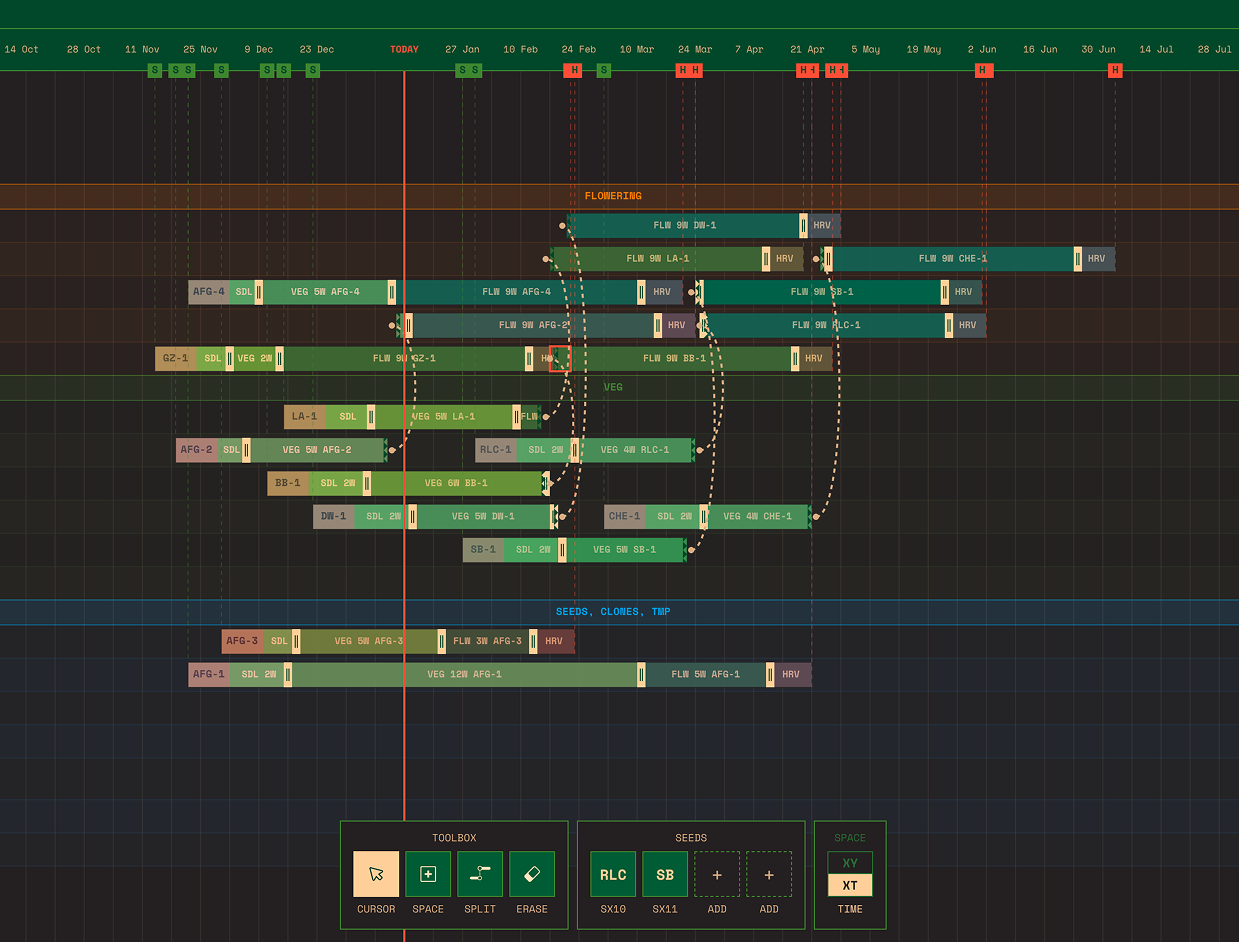
Drag plants across time. See germination through harvest. Start planning →
FAQ
Q1: Can I run autoflowers in a perpetual harvest setup?
A1: Yes, but it’s trickier. Autos flower based on age, not light cycle. To run them perpetually, you’d need a dedicated space and to stagger your plantings by a week or two. Photoperiod strains are generally much easier to manage in a strict multi-tent perpetual schedule because you control the flip to flower. Our guide on The Complete Guide to Perpetual Harvest: Never Run Out Again goes into more detail on this.
Q2: How many plants can I realistically grow in a multi tent setup?
A2: This depends entirely on your tent sizes, your local regulations (if applicable), and your desired yield. A 2x2 tent is usually good for 1-2 plants in veg, while a 4x4 can comfortably hold 4-6 plants depending on training. Always refer to spacing guides and avoid overcrowding. Plantegia’s Space view can help you visualize this.
Q3: What’s the minimum number of tents I need for a perpetual harvest?
A3: Technically, you can achieve a very basic perpetual harvest with just two tents: one for veg and one for flower. However, a third tent or dedicated space for clones/seedlings makes the process much smoother and less disruptive to your main tents.
Q4: How long should my vegetative stage be in a multi tent setup?
A4: It varies by strain and your desired plant size. Typically, photoperiod plants stay in veg for 4-8 weeks. Techniques like LST (Low-Stress Training) and SCROG (Screen of Green) can extend this time as you train the plant to fill a larger space horizontally before flipping. The goal is to have a plant that’s mature enough to produce well in flower, but not so large that it overpowers your flower tent.